

Meditation is often associated with mindfulness apps, yoga studios, wellness retreats, and modern stress-management techniques. But meditation is far more than a contemporary wellness trend. Its history stretches back thousands of years and is closely connected with ancient traditions, spirituality, philosophy, and the human search for inner peace.
From the ancient meditation practices of India to Buddhist traditions and today’s mindfulness movement, meditation has continuously evolved while maintaining one central purpose: helping people develop greater awareness of the mind and present moment.
In this article, we will explore the history of meditation, its ancient origins, important meditation techniques, and how meditation became a worldwide practice.
What Is Meditation? Understanding Awareness and Concentration
Meditation is a practice that involves training attention and awareness. Depending on the tradition, it may involve focusing on the breath, observing thoughts, repeating a word or phrase, developing compassion, or simply becoming aware of the present moment.
Different cultures and traditions have developed their own meditation techniques over thousands of years. Some practices focus on concentration, while others emphasize observation, contemplation, compassion, or awareness.
Some common forms include:
- Mindfulness meditation
- Buddhist meditation
- Vipassana meditation
- Samatha meditation
- Loving-kindness meditation
- Mantra meditation
- Transcendental meditation
- Walking meditation
- Breath awareness meditation
Although these techniques differ, many share the goal of developing greater mental clarity, self awareness, concentration, and emotional balance.
The Ancient Origins of Meditation and Early Meditation Practices
The exact beginning of meditation is difficult to determine because many early practices were passed down orally rather than recorded in written form.
Some of the earliest evidence of contemplation and meditative practices can be connected with ancient India.
Meditative traditions developed alongside philosophical and spiritual systems that explored questions about consciousness, suffering, existence, and the nature of the self.
Meditation gradually became a way of turning attention inward and exploring the relationship between the mind and experience.
Meditation in Ancient India
The roots of meditation are particularly strong in the ancient Indian spiritual traditions.
The Vedas, some of the oldest surviving sacred texts from India, contain references to practices associated with contemplation and spiritual discipline. Later texts, including the Upanishads, explored ideas related to the mind, consciousness, self-knowledge, and meditation.
The Upanishadic traditions encouraged people to look beyond external experiences and explore their inner nature.
This marked an important development in the history of meditation because meditation gradually became more than a ritual. It became a method of self-inquiry and self awareness.
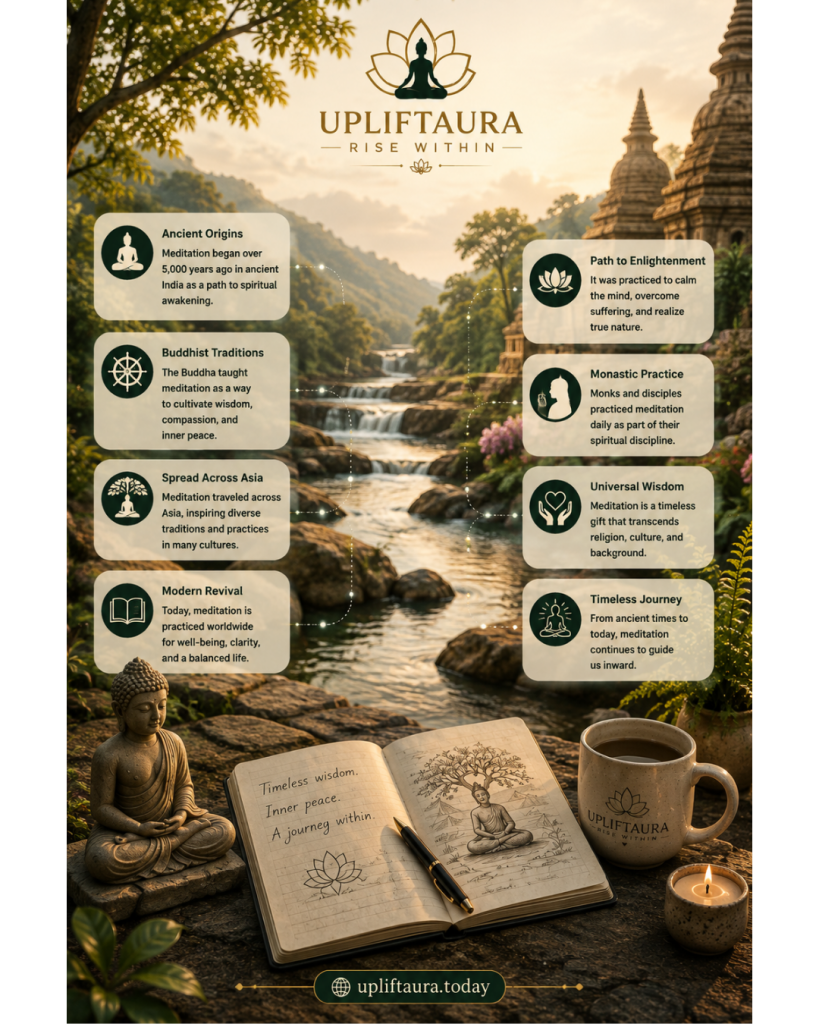
Meditation and the Upanishads: Contemplation and Consciousness
The Upanishads, composed over a long period beginning more than two thousand years ago, played an important role in the development of Indian contemplative philosophy.
They explored profound questions such as:
- Who am I?
- What is consciousness?
- What is the nature of reality?
- How can a person overcome suffering?
- What is the relationship between the individual and the universe?
Meditative contemplation became one way of exploring these questions.
The relationship between meditation and consciousness became particularly important because practitioners were encouraged to look inward and examine the nature of their own experience.
This period helped establish an important idea that remains relevant today: understanding the mind can be a path toward understanding oneself.
The Development of Buddhist Meditation Practices
One of the most influential chapters in the history of meditation began with the rise of Buddhism in ancient India.
Siddhartha Gautama, who later became known as the Buddha, practiced different forms of meditation before developing his own path toward awakening.
Meditation became a central part of Buddhist practice.
Buddhist traditions developed several important meditation practices, including methods designed to cultivate calmness, insight, compassion, awareness, and concentration.
Samatha Meditation and Concentration
Samatha is commonly associated with calming and stabilizing the mind.
Practitioners may focus their attention on an object such as the breath. Through repeated practice, the mind becomes more concentrated and less distracted.
This makes concentration an important part of many traditional meditation techniques.
The practitioner repeatedly brings attention back to the chosen object instead of becoming lost in thoughts and distractions.
Vipassana Meditation and Self Awareness
Vipassana, often translated as insight meditation, emphasizes observing experiences as they arise and pass away.
Rather than trying to control every thought, practitioners develop awareness of sensations, emotions, and mental activity.
This process can encourage self awareness because the practitioner learns to observe thoughts and feelings without immediately reacting to them.
Vipassana has become particularly well known around the world through modern meditation courses and teachers.
Metta Meditation and Inner Peace
Another important Buddhist practice is Metta Bhavana, commonly known as loving-kindness meditation.
The practice involves developing feelings of goodwill, kindness, and compassion toward oneself and others.
The cultivation of kindness and compassion has made Metta an important meditation practice for people interested in emotional balance and inner peace.
These Buddhist meditation traditions significantly influenced the development of meditation across Asia and eventually throughout the world.
Meditation in Hindu Traditions: The Meaning of Dhyana
Meditation also continued to develop within Hindu philosophical and spiritual traditions.
The Yoga Sutras of Patanjali, traditionally associated with the sage Patanjali, provided an influential framework for yoga philosophy.
Patanjali described a progressive path involving ethical principles, physical practices, breath regulation, concentration, meditation, and deeper states of mental absorption.
In this framework, meditation was not simply a relaxation exercise. It was part of a broader discipline aimed at cultivating control of attention and deeper understanding.
The Sanskrit concept dhyana, often translated as meditation, became an important part of this tradition.
The concept of dhyana is particularly significant when studying the history of meditation because it reflects the ancient development of sustained mental attention and contemplative practice.
Meditation Techniques Spread Across Asia
As Buddhism and other Indian philosophical traditions spread, different meditation techniques traveled to various parts of Asia.
Meditation in China
Buddhist meditation reached China and interacted with existing Chinese philosophical traditions, including Taoism.
Over time, different schools of Chinese Buddhism developed distinctive approaches to meditation.
One major tradition eventually became known as Chan Buddhism.
Meditation in Japan
Chan Buddhism later influenced Zen Buddhism in Japan.
Zen meditation is particularly associated with sitting meditation, commonly known as zazen.
Zen places strong emphasis on direct awareness and observing experience without unnecessary conceptualization.
Today, Zen meditation remains one of the most recognizable meditation traditions worldwide.
Meditation in Tibet
Tibetan Buddhist traditions developed sophisticated meditation practices involving visualization, compassion, awareness, and philosophical contemplation.
Tibetan meditation includes numerous methods and is part of a broader spiritual path involving study, ethical practice, and mental training.
Meditation in Other Religious Traditions
Meditative and contemplative practices have not been limited to Hinduism and Buddhism.
Various forms of contemplation, prayer, repetition, silence, and focused attention have appeared in different religious traditions throughout history.
Christian contemplative traditions, Islamic mystical traditions, Jewish meditation practices, and other spiritual paths have included practices designed to encourage inner reflection and a deeper connection with the sacred.
Although their beliefs and methods differ, many contemplative traditions share a common human desire: to become quieter, more attentive, and more deeply aware.
Meditation Enters the Modern World
For much of history, meditation was primarily practiced within religious or philosophical traditions.
During the 19th and 20th centuries, however, interest in Asian philosophy and meditation increased in Europe and North America.
Teachers, scholars, travelers, and spiritual communities introduced different meditation traditions to Western audiences.
Meditation gradually moved beyond religious settings and began to be explored as a practice for mental training and personal development.
The Rise of Mindfulness Meditation
One of the biggest developments in modern meditation history has been the growth of mindfulness meditation.
Mindfulness involves intentionally paying attention to present-moment experiences with an attitude of awareness and non-reactivity.
Modern mindfulness practices have helped introduce meditation to people who may not follow a particular religious or spiritual tradition.
Mindfulness can involve noticing breathing, physical sensations, thoughts, and emotions without immediately judging or reacting to them.
This makes mindfulness closely connected with self awareness and present-moment attention.
Breath Awareness in Meditation
Breath awareness is one of the simplest and most widely recognized meditation techniques.
A practitioner can sit quietly and observe the natural movement of breathing.
The purpose is not necessarily to change the breath. Instead, attention is gently placed on the sensations of inhaling and exhaling.
When the mind wanders, attention is brought back to the breath.
This simple practice connects several important elements of meditation: concentration, mindfulness, self awareness, and breath awareness.
Breath-based meditation also demonstrates why meditation does not always require complicated techniques. Sometimes, simply observing the present moment can become the foundation of a regular practice.
Meditation in the 21st Century
Today, meditation is practiced by millions of people around the world.
It can be found in:
- Schools and universities
- Workplaces
- Healthcare settings
- Yoga studios
- Meditation centers
- Sports training
- Wellness programs
- Mobile applications
- Online courses
Technology has made meditation more accessible than ever.
People can now learn breathing exercises, guided meditation, mindfulness techniques, and relaxation practices through smartphones and online platforms.
However, the basic principle remains remarkably similar to ancient traditions: training attention and becoming more aware of the mind.
Why Has Meditation Survived for Thousands of Years?
The long history of meditation raises an interesting question: why has this practice survived for so many centuries?
One reason may be its simplicity.
Meditation does not necessarily require expensive equipment, a special location, or complicated preparation. A person can begin by simply sitting quietly and paying attention to their breathing.
Another reason is that meditation addresses something universal: the human mind.
People have always experienced distraction, worry, anger, desire, fear, and uncertainty. Meditation offers a structured way to observe these experiences rather than automatically reacting to them.
Its forms have changed across cultures, but the fundamental human need for greater awareness and inner peace has remained.
Ancient Meditation vs. Modern Meditation Techniques
Modern meditation is often presented as a tool for relaxation, productivity, or stress management.
Ancient meditation traditions generally had broader philosophical and spiritual objectives.
| Ancient Meditation | Modern Meditation |
|---|---|
| Spiritual development | Mental well-being |
| Self-inquiry | Stress management |
| Liberation from suffering | Relaxation |
| Concentration and awareness | Improved focus |
| Ethical and philosophical practice | Personal development |
| Understanding consciousness | Present-moment awareness |
Modern meditation techniques are often adapted from much older traditions. Understanding this history can help us appreciate meditation beyond its modern wellness image.
The Science of Meditation, Mindfulness, and Self Awareness
Modern researchers have become increasingly interested in meditation and mindfulness.
Studies have explored meditation in relation to attention, emotional regulation, stress, sleep, and overall psychological well-being.
However, meditation should not be viewed as a magical solution to every problem. Research findings vary depending on the technique, population, study design, and outcome being measured.
A practical approach is to view meditation as a skill that develops through regular practice, rather than something that produces instant transformation.
How to Start Meditation for Inner Peace
You do not need to understand thousands of years of meditation history before beginning.
A simple practice can take only a few minutes.
Try This 5-Minute Breath Awareness Meditation
- Sit comfortably.
- Close your eyes or soften your gaze.
- Notice your natural breathing.
- Pay attention to the sensation of inhaling and exhaling.
- When your mind wanders, gently bring your attention back to the breath.
- Continue for five minutes.
- Open your eyes and notice how you feel.
The goal is not to stop thinking.
The goal is to notice when your mind wanders and gently return your attention.
With consistent practice, even a few minutes each day can become a meaningful part of your routine and may support greater mindfulness and self awareness.
The Continuing Evolution of Meditation
The history of meditation is not finished.
Ancient meditation practices continue to influence modern approaches, while scientific research and technology continue to introduce meditation to new audiences.
From quiet forest monasteries and ancient Indian philosophical traditions to smartphones and modern workplaces, meditation has traveled an extraordinary journey.
Yet its central practice remains simple: pause, observe, and become aware.
Perhaps that is one reason meditation has remained relevant for thousands of years.
Final Thoughts
The history of meditation is a story of human curiosity, self-exploration, spirituality, and the search for inner understanding.
From ancient Indian traditions to Buddhist meditation, Zen, Tibetan practices, and modern mindfulness, meditation has taken many forms across cultures and centuries.
The history of meditation also shows how concepts such as dhyana, contemplation, consciousness, concentration, breath awareness, and self awareness have remained connected to humanity’s desire to understand the mind.
While modern meditation is sometimes promoted primarily as a way to relax or improve productivity, its historical roots reveal something much deeper. Meditation has long been used as a way to understand the mind, develop awareness, and explore the relationship between our thoughts, emotions, and experiences.
You don’t have to become a monk or spend hours meditating to begin. Starting with just a few quiet minutes each day can be enough to explore your own mind and develop a greater sense of awareness and inner peace.
Meditation has changed across thousands of years, but one thing remains constant: the journey inward.
Frequently Asked Questions
When Did Meditation Begin?
The exact origin of meditation cannot be identified with certainty. Some of the earliest documented contemplative traditions are associated with ancient India and date back thousands of years.
What Is the Oldest Form of Meditation?
There is no single practice that can definitively be called the oldest form of meditation. Early Indian contemplative traditions included practices involving concentration, contemplation, breath awareness, and self-inquiry.
Who Started Meditation?
Meditation was not invented by one individual. Different forms of meditation developed gradually across ancient cultures. Buddhism later played a major role in spreading meditation practices across Asia.
What Is Dhyana in Meditation?
Dhyana is a Sanskrit term commonly translated as meditation or meditative absorption. It became an important concept in Indian philosophical and yogic traditions.
What Is the Difference Between Ancient and Modern Meditation?
Ancient meditation was often connected with spiritual development, philosophical inquiry, and liberation from suffering. Modern meditation is frequently practiced for mindfulness, relaxation, focus, and general well-being.
Is Meditation a Religious Practice?
Meditation can be part of a religious or spiritual tradition, but it can also be practiced in secular settings. The purpose and method depend on the individual and the type of meditation being practiced.
How Long Should a Beginner Meditate?
Beginners can start with 5 to 10 minutes a day. The most important factor is consistency rather than meditating for long periods.
Disclaimer: The information provided on UpliftAura is for general educational, informational, and inspirational purposes only. It is not intended to replace professional medical, mental-health, financial, legal, or other professional advice. Meditation and wellness practices may affect individuals differently. Always consult a qualified professional regarding your specific circumstances. UpliftAura does not guarantee any particular results from the use of its content.