

Sometimes, you don’t need more motivation. You need a decision.
We often tell ourselves, “I’ll start when I feel motivated.” We wait for the right mood, the right time, or that sudden burst of energy that makes everything feel easier.
But motivation is unpredictable. Some days it is there, and some days it disappears completely.
Discipline is different.
Discipline helps you keep moving even when you don’t feel motivated. It teaches you to take action because something matters to you not simply because you feel like doing it.
If you want lasting personal growth, better habits, and meaningful progress, learning self-discipline may be more valuable than constantly searching for motivation.
Discipline Over Motivation: Understanding the Difference
Motivation and discipline are connected, but they are not the same thing.
Motivation is a feeling. Discipline is a practice.
Motivation can inspire you to start something. Discipline helps you continue when the excitement fades.
For example, you may feel motivated to exercise after watching an inspiring video. You might feel excited about starting a new routine on Monday. But when you wake up tired on Wednesday, motivation may not be enough.
Discipline says:
“I don’t feel like doing this today, but I know it matters, so I’ll do it anyway.”
That doesn’t mean forcing yourself to work endlessly or ignoring your need for rest. It means learning to make choices based on your priorities instead of your temporary emotions.
This is the real meaning of discipline over motivation: you don’t allow your mood to decide whether you take action.
Staying Motivated: Why Waiting for Motivation Keeps You Stuck
Waiting for motivation sounds harmless, but it can quietly become a habit.
You postpone exercising because you’re tired.
You delay studying because you’re not in the mood.
You avoid starting a project because you don’t feel confident.
You tell yourself you’ll begin tomorrow.
Then tomorrow becomes next week.
The problem isn’t always laziness. Sometimes we’re simply expecting motivation to come before action.
In reality, action often creates motivation.
Once you take the first small step, your mind gets evidence that you are capable of moving forward. That small achievement can create momentum, and momentum makes the next step easier.
Instead of constantly asking yourself how to stay motivated, focus on creating a system that helps you take action even when motivation is low.
Self-Discipline: Learn to Keep Promises to Yourself
One of the most powerful parts of self-discipline is learning to trust yourself.
Every time you make a promise to yourself and keep it, you strengthen that trust.
It doesn’t have to be a huge promise.
Maybe you decide to:
- Read for 15 minutes every day.
- Walk for 20 minutes.
- Meditate for 10 minutes.
- Spend less time scrolling on your phone.
- Work on an important goal for 30 minutes.
- Go to bed at a reasonable time.
Small commitments may seem insignificant, but they build something important: self-respect.
You begin to see yourself as someone who follows through.
And when you trust yourself, taking action becomes easier.
How to Build Discipline Without Trying to Be Perfect
A common mistake when learning how to build discipline is thinking that discipline means following your routine perfectly every single day.
It doesn’t.
You will have difficult days. You may get tired, distracted, busy, or simply lose your rhythm.
The goal isn’t perfection.
The goal is returning.
If you miss one workout, return the next day.
If you skip meditation, start again tomorrow.
If you waste a day, don’t waste the entire week feeling guilty about it.
Discipline isn’t about never falling off track.
It’s about learning to get back on track.
When you stop demanding perfection from yourself, it becomes easier to stay consistent.
Build Better Habits With Small Daily Actions
Trying to completely change your life overnight usually doesn’t work.
Instead, build better habits one step at a time.
If you want to become more productive, don’t create a routine with fifteen new habits. Choose one important task and complete it consistently.
If you want to start meditation, begin with five or ten minutes.
If you want to exercise, start with a manageable routine.
If you want to read more, begin with a few pages each day.
Small actions are easier to repeat, and repeated actions gradually become habits.
Consistency beats intensity when you’re building a life for the long term.
Productive Habits: Make Discipline Easier With a Simple Routine
You don’t always need stronger willpower. Sometimes you need a better environment and a few productive habits.
If your phone constantly distracts you, keep it away while working.
If you want to exercise in the morning, prepare your clothes the night before.
If you want to meditate daily, choose a fixed time and place.
If you want to read before bed, keep your book where you can easily see it.
The less friction you create around a good habit, the easier it becomes to maintain.
Your environment can either support your discipline or constantly fight against it.
Daily Discipline: Do the Next Small Thing
One of the hardest lessons in daily discipline is learning to act even when you don’t feel like doing something.
You won’t always feel confident.
You won’t always feel energetic.
You won’t always feel inspired.
And that’s normal.
There will be days when your goals feel far away and your progress seems too slow.
Those are the days when discipline matters most.
You don’t have to complete everything perfectly. Sometimes the disciplined choice is simply to do the next small thing.
Write one paragraph.
Take a short walk.
Read one page.
Meditate for five minutes.
Send the email.
Clean your workspace.
Small actions keep the connection between you and your goals alive.
Discipline in Life Doesn’t Mean Being Hard on Yourself
There is a difference between discipline and punishment.
Discipline in life doesn’t mean criticizing yourself every time you make a mistake.
Real discipline includes understanding your limits.
Rest when you genuinely need rest. Adjust your routine when something isn’t working. Learn from mistakes instead of using them as reasons to give up.
A healthy approach to discipline is firm but kind.
You can hold yourself accountable without becoming your own enemy.
The goal is not to create a life where you are constantly pushing yourself.
The goal is to create a life where your actions support the person you want to become.
Personal Growth: Stop Comparing Your Progress With Others
Another reason people lose motivation is comparison.
You see someone else’s success and wonder why you’re not there yet.
But you don’t know how long they’ve been working, what challenges they’ve faced, or what their journey looked like before you noticed the results.
Your responsibility is not to become someone else.
Your responsibility is to become a little stronger, wiser, calmer, and more consistent than you were before.
Personal growth is not a competition.
Some seasons of life will bring fast progress. Others will require patience.
Keep going anyway.
Your journey doesn’t have to look impressive to everyone else to be meaningful to you.
Achieving Goals: Build a Life That Doesn’t Depend on Motivation
When it comes to achieving goals, imagine waking up and knowing what matters without having to negotiate with yourself every morning.
You don’t need to ask:
“Do I feel like doing this?”
Instead, ask:
“Is this important to me?”
If the answer is yes, take the next step.
That mindset changes everything.
You stop depending completely on your emotions and start making choices based on your values and long-term goals.
That’s what discipline really gives you: freedom from constantly waiting to feel ready.
Motivation and Discipline: A Simple 5-Step Practice
If you want to strengthen motivation and discipline in your everyday life, start with these five steps:
1. Choose One Important Goal
Don’t try to fix everything at once. Decide what matters most right now.
2. Make the Goal Smaller
Turn a big goal into a daily action that feels achievable.
3. Choose a Fixed Time
A consistent time makes a habit easier to remember and repeat.
4. Track Your Progress
A simple calendar or journal can help you see your consistency and recognize your progress.
5. Never Miss Twice
Missing one day doesn’t destroy your progress. Allowing one missed day to become a week can.
If you fall off track, return as quickly as possible.
Consistency: The Real Secret Is Showing Up
Success isn’t always about doing something extraordinary.
Sometimes it is about doing ordinary things with consistency.
The person who reads a few pages every day eventually finishes books.
The person who saves a little money regularly eventually builds savings.
The person who practices a skill consistently eventually becomes better.
The person who takes care of their mind every day gradually develops greater self-awareness and inner strength.
Progress can be quiet.
You may not notice it every day.
But that doesn’t mean it isn’t happening.
Consistency is powerful because small actions, repeated over time, can create results that one intense burst of effort rarely can.
How to Build Discipline When You Want to Give Up
There will be moments when you question whether your effort is worth it.
You may feel tired.
You may feel behind.
You may wonder whether your goals are realistic.
This is where learning how to build discipline becomes important.
Instead of thinking about the entire journey, focus on today.
Ask yourself:
“What is one thing I can do today that will move me forward?”
Maybe it’s only ten minutes.
That’s okay.
Ten focused minutes are better than another day spent waiting for the perfect motivation.
You don’t need to see the entire staircase.
You only need to take the next step.
Discipline Over Motivation: Choose Action Over Mood
The biggest lesson is simple:
Don’t let your feelings become the boss of your goals.
Your feelings matter, but they don’t always need to make the final decision.
You can feel nervous and still begin.
You can feel tired and still take one small step.
You can feel uncertain and still learn.
You can feel unmotivated and still show up.
That is discipline over motivation.
Not because motivation is useless, but because motivation cannot be expected to appear every day.
A Phrase for You, the Reader
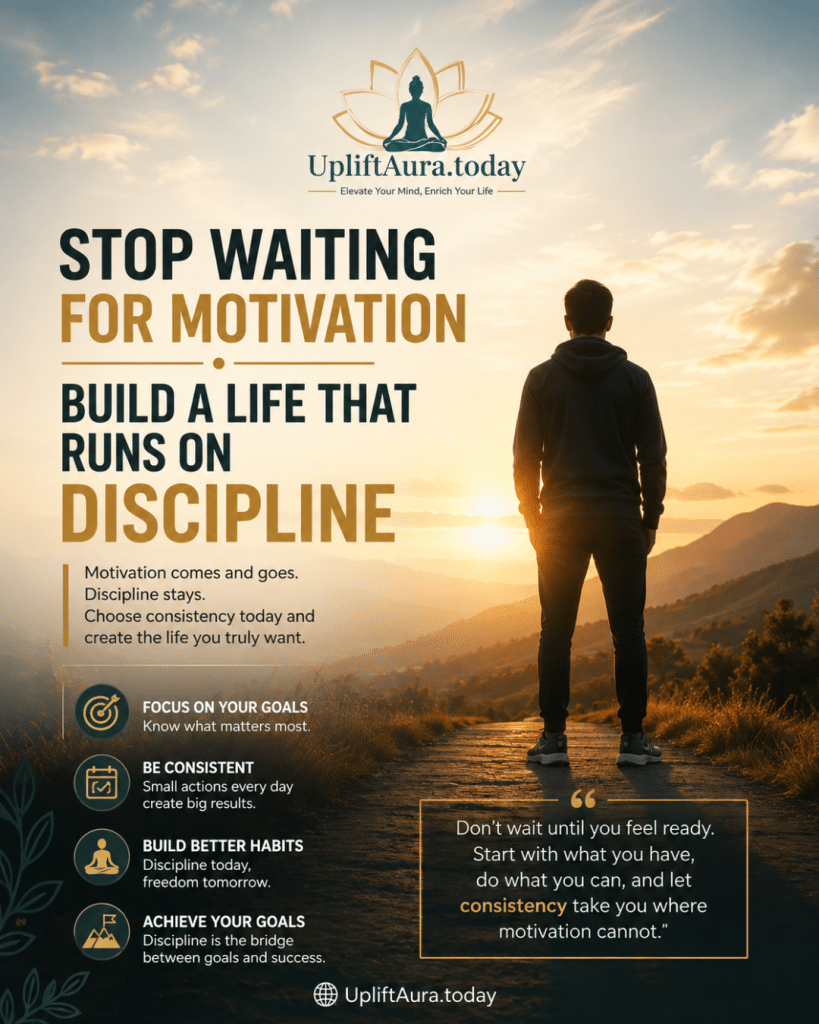
“Don’t wait until you feel ready. Start with what you have, do what you can, and let consistency take you where motivation cannot.”
Remember this on the days when you don’t feel inspired.
You don’t need to win the entire day.
You only need to take the next right step.
Final Thoughts: Build a Life on Discipline
Motivation can give you a beautiful beginning, but discipline helps you build something that lasts.
There will always be days when you don’t feel like working toward your goals. That’s part of being human.
Don’t wait for the perfect mood.
Don’t wait for the perfect Monday.
Don’t wait until you suddenly become confident.
Start small.
Stay consistent.
Build better habits.
Keep showing up.
Give yourself permission to make mistakes and begin again.
Because a better life isn’t usually created by one huge decision.
It is built through the small decisions you repeat every day.
And sometimes, the most powerful thing you can tell yourself is simply:
“I don’t have to feel motivated. I just have to begin.”
Disclaimer: The information provided on UpliftAura is for general educational, informational, and inspirational purposes only. It is not intended to replace professional medical, mental-health, financial, legal, or other professional advice. Meditation and wellness practices may affect individuals differently. Always consult a qualified professional regarding your specific circumstances. UpliftAura does not guarantee any particular results from the use of its content.